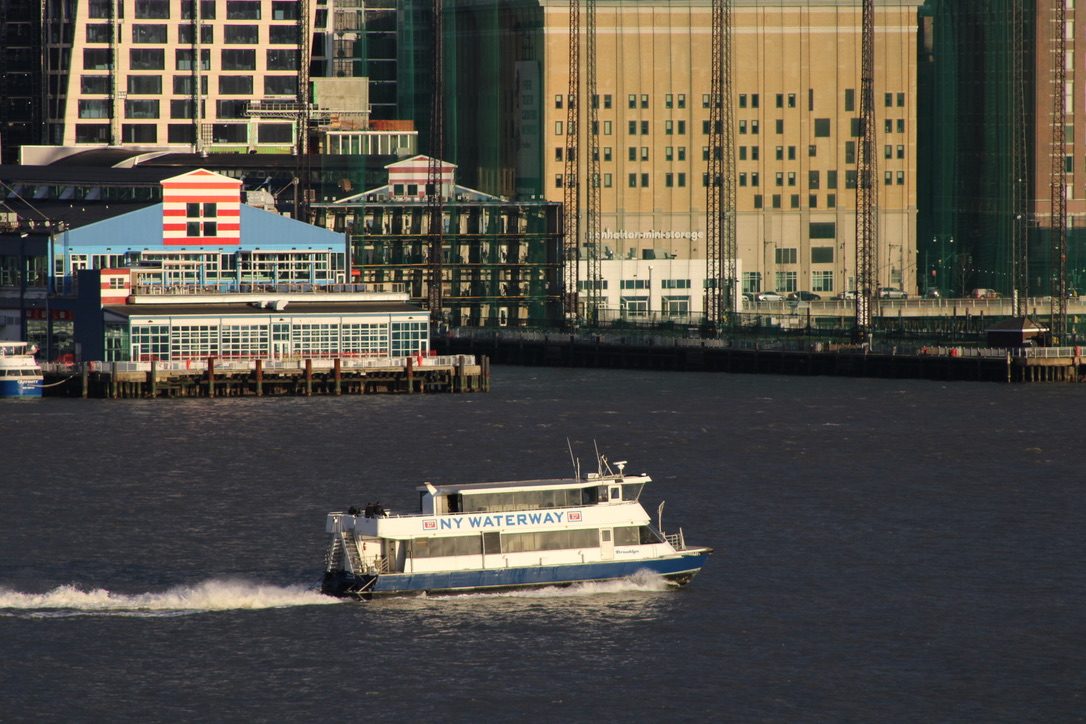
Ferry and boat waves.
Boats cross the Hudson all day, and the waves they leave behind roll onto Hoboken's shore minutes later.
Watch a ship pass the cove
Boats cross the Hudson all day, and the waves they leave behind roll onto Hoboken's shore minutes later.
Watch a ship pass the coveHoboken Surf Club does not endorse riding waves from ferries or any other vessel. Never ride, follow, chase or position yourself near a moving vessel to ride its wake: large vessels cannot see you or stop quickly, and their wakes are stronger and more sudden than they look. This page looks only at waves that have already reached the shore.
Pick a ship, set its speed and how far offshore it runs, and watch the wake travel to the two spots on this shore. The numbers show the physics behind what you see. It is a teaching model, not a forecast: wake sizes are a relative index, and piers and shore are drawn schematically.
Wake size is a 0 to 100 teaching index, not a measured height. How it works.
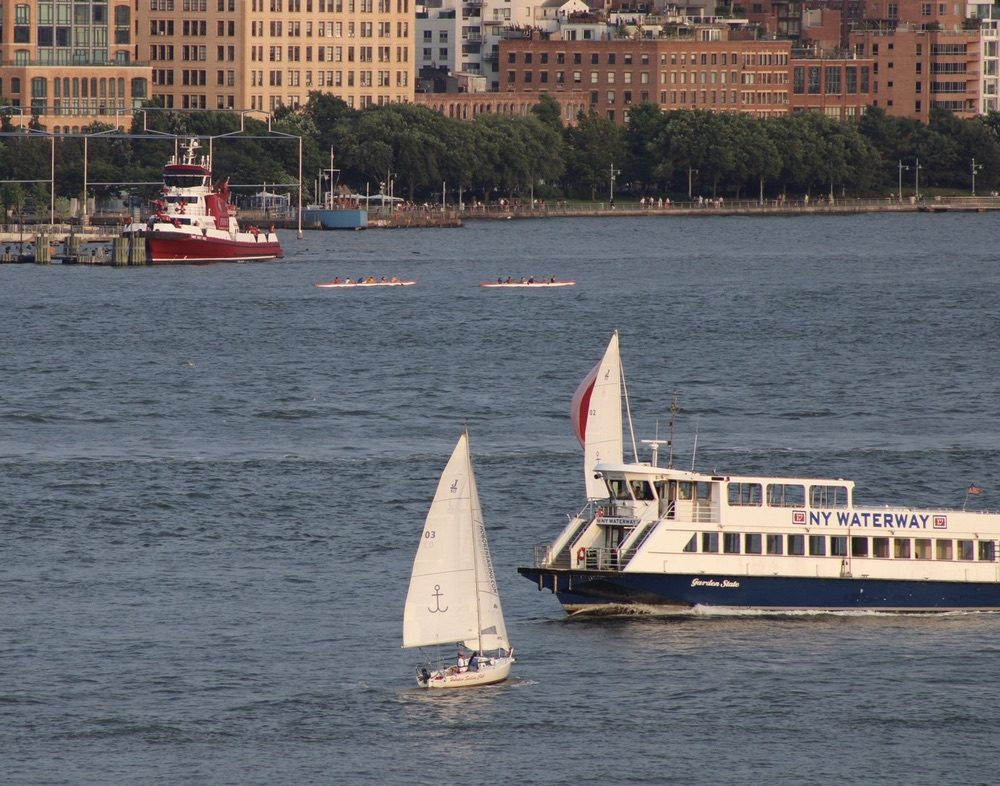
The river is busy: ferries share it with sailboats, kayaks, tugs and ships. Pick a spot to see the next crossings in front of it, which tells you when wakes will reach that shore. Example times The real tool will read published ferry schedules.
| Next crossing | In | Boat |
|---|
Wake size depends on the boat, its speed and the water depth. This tool cannot tell you how big a wake will be, or whether to be on the water.
A moving hull creates high pressure at the bow and stern and low pressure along its sides. The water responds with waves. In deep water those waves form two sets: transverse waves that run across the track, and divergent waves that fan out. They meet along two lines, the cusps, that trail the ship at 19.47 degrees. That angle, arcsin of one third, does not depend on the ship's size or speed in deep water.
For the curious: the depth effect is the depth Froude number, boat speed divided by the square root of gravity times depth. Wakes change character as it approaches 1. Real numbers for each ferry route still need to be measured.
The transverse wave a ship makes has a wavelength of 2πV²/g, so it gets longer as the square of speed. When that wavelength equals the hull length, the ship sits between its own bow and stern crests. That happens at a length Froude number, V divided by the square root of g times length, of about 0.4, which is the classic hull speed (about 1.34 times the square root of length in feet, in knots). Beyond it a displacement hull climbs its own bow wave and wake energy rises steeply. Short, fast ferries operate in this range. Long, slow ships do not.
Shallow water changes how fast waves can travel. The limit is the square root of g times depth. The ratio of ship speed to that limit is the depth Froude number. Well below 0.7 the classic wedge holds. Approaching 1, the cusp angle opens and waves bunch up, so the same ship makes a larger wake. At 1, waves cannot run ahead of the ship, and energy piles into one big wave. Above 1 the wake narrows again to a wedge of arcsin(1 over the Froude number). Move the depth slider and watch the angle.
A fast ferry is short and light, so its waves have short wavelengths and periods but can be steep and sharp. A tanker or cruise ship moves a huge volume of water, but at harbour speeds its length Froude number is small, so its wake is low and long. Both can arrive at the shore larger than they looked offshore, and large ships can also pull water away from the shore and then return it as a surge. How a particular ship behaves depends on its hull shape and trim, which this model does not capture.
As a wave enters shallower water it slows, and by Green's law its height grows with the depth to the minus one quarter. Crests bend to follow the seabed (refraction), so they arrive nearly parallel to the shore. The wave steepens and breaks when its height reaches roughly three quarters of the local depth. This is why a wake that looks small in the channel can break right at the edge, and why the ride is short. The "Depth near the shore" slider shows how much more a wave grows in shallower water.
Structures shape the wave on its way in. A pier or point can block it, bend it around the tip (diffraction) and leave a calmer pocket behind. Hard bulkheads reflect waves back out, so the water near the shore becomes a confused mix of incoming and returning crests. In the model, the pier shelters whichever spot sits on the far side from the oncoming wake. Which side that is depends on the ship's heading. The real values are for us to measure on the water.
Period is the time between crests. The waves along the cusps have a period of about 2π times 0.82 times V over g. Longer-period waves carry more energy and run up further. For an 18 knot ferry that is about 4.8 seconds, for a tanker at 8 knots about 2.1 seconds. A longer period generally means a wave that feels deeper and pushes further up the shore.
The same wake looks different from one spot to the next, even inside one cove. Water depth (bathymetry) decides how the wave steepens as it nears shore. Piers block, bend or reflect it, and the shape of the land can focus or spread it. The spot notes are placeholders until we confirm them on the water.
Hoboken Cove south of the Maxwell Pier point. Our main break.
North of Maxwell Pier, where the point opens to the bigger embayment.
Relative wake size is a 0 to 100 teaching index on one scale for all ships. It combines the hull's displacement, its length Froude number, how close the depth Froude number is to 1, how the wake spreads with distance, how the wave grows in shallow water near shore, and a schematic shelter factor for the pier. It is not a measured height. Ship sizes are illustrative classes, and the depths are placeholders until we have local data.
Wind blowing against the tide builds waves you can ride a long way downriver.