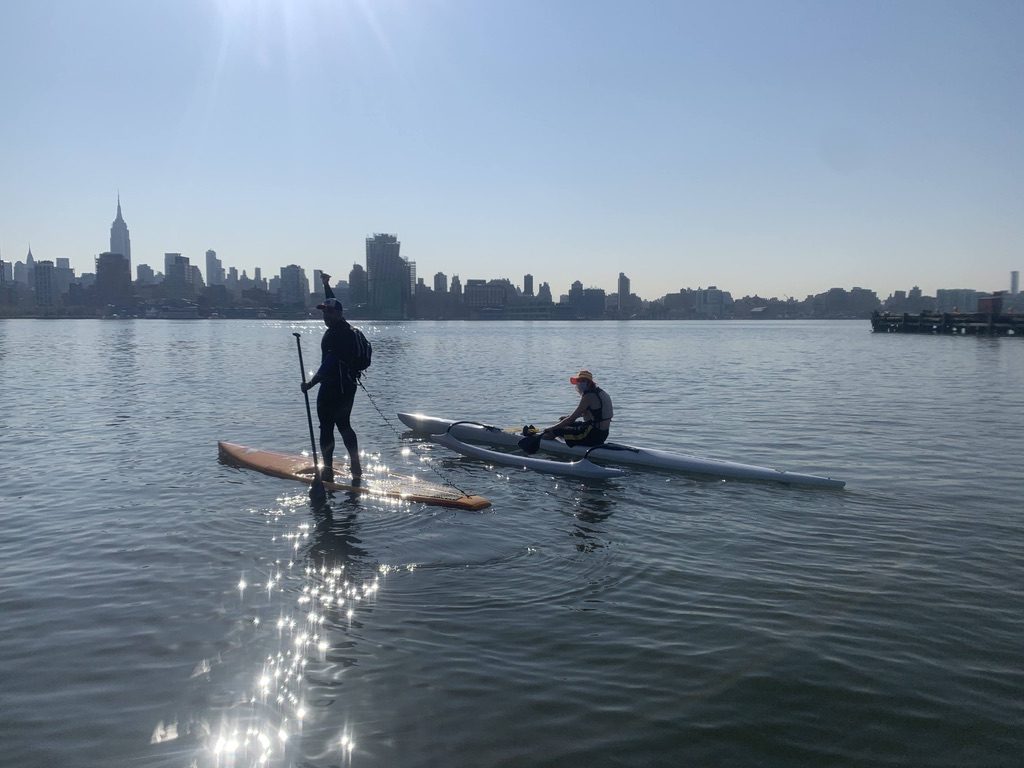
What about the water itself?
Everyone asks, and it is a fair question. The Hudson has come a long way, and it still has days when you should keep out of it.
After the rain
Everyone asks, and it is a fair question. The Hudson has come a long way, and it still has days when you should keep out of it.
After the rainRain washes sewage and street runoff into the Hudson, and germ levels can stay above swimming guidelines for days after a storm.
Pick how hard it rained and how long ago it stopped. The tool shows the general pattern river groups describe. It does not measure the water and cannot tell you what is in it today.
Illustrative shape only. Real water quality depends on the storm, the tide, the outfall and the day, and this graph is not a measurement.
General guidance, not medical or legal advice.
Hoboken Cove Community Boathouse, Ke Aloha Outrigger and Resilience all run programs at the Hoboken waterfront. Ask them about schedules and how they handle rain and water quality.
Live outfall status near the Hudson at Hoboken and north. nhudsonsa.com
Sampling results and guidance for the Hudson and New York City waterways. riverkeeper.org
Guidance on contact with the river after rain. Read the guidance
A New York City volunteer program that publishes weekly results. Example results
Where the 35 and 130 reference values come from. EPA fact sheet
For sewer odors, backups or suspected breaks, NHSA lists (866) 689-3970.
Independent organizations, not part of Hoboken Surf Club. Links are for education and may change. General guidance, not medical or legal advice.
In older cities like Hoboken, one network of pipes carries both household sewage and street runoff. On a dry day that all goes to a treatment plant. In a heavy rain the pipes fill faster than the plant can take the flow, and the extra is released into the river through outfalls. These releases are called combined sewer overflows, or CSOs, and what comes out is minimally treated sewage mixed with stormwater.
North Hudson Sewerage Authority (NHSA) runs the outfalls along this stretch of the river, from West New York south to Hoboken. Each one is marked with a sign and an identification number.
This is also where the tide matters. The river runs both ways, so water from an outfall can be carried upriver on the flood and back down on the ebb, past the same shoreline more than once.
Sewage bacteria are the main concern for people on the water, because swallowing or touching contaminated water can make you sick. Scientists measure them with an indicator organism called enterococcus. Finding it in a sample is a signal that sewage may be in the water.
Here is what the local sewer authority has published about its own effort. Check the sources for current numbers, because projects and counts change.
NHSA reports that it has eliminated three of its twelve historic outfalls, leaving nine active in its 2019 newsletter.
NHSA reports relining more than 5.5 miles of sewers and building detention tanks under parks, so some storm flow is held and sent for treatment later.
Rain gardens, permeable surfaces and similar projects keep stormwater out of the pipes in the first place.
In 2015, NJDEP required every combined sewer system in New Jersey to develop a Long-Term CSO Control Plan. NHSA reports about $65 million invested so far.
NHSA's Waterbody Advisory System uses sensors in the sewer system and shows each outfall on a map. Red means an overflow is happening and contact within 100 feet of that outfall should be avoided.
Riverkeeper and community volunteers sample the Hudson for sewage-indicating bacteria and publish the results, so the public can see the water for themselves.
Figures come from NHSA's 2019 CSO newsletter and Waterbody Advisory page. They are the authority's own numbers and may be out of date.
If you look at sampling results, you will see counts of enterococcus per 100 milliliters of water. The EPA's 2012 recreational water quality criteria give two reference values for enterococcus, and either set may be used.
The alternate set is 30 and 110. These are criteria for protecting public health at swimming beaches, and a river sample close to an outfall can be far above them after rain. A single result is a snapshot of one spot at one hour, and conditions can change within hours as rain, tide and overflows come and go.